
Full Building Demolition
Complete removal of commercial structures with equipment, hauling and site closeout matched to the redevelopment plan.
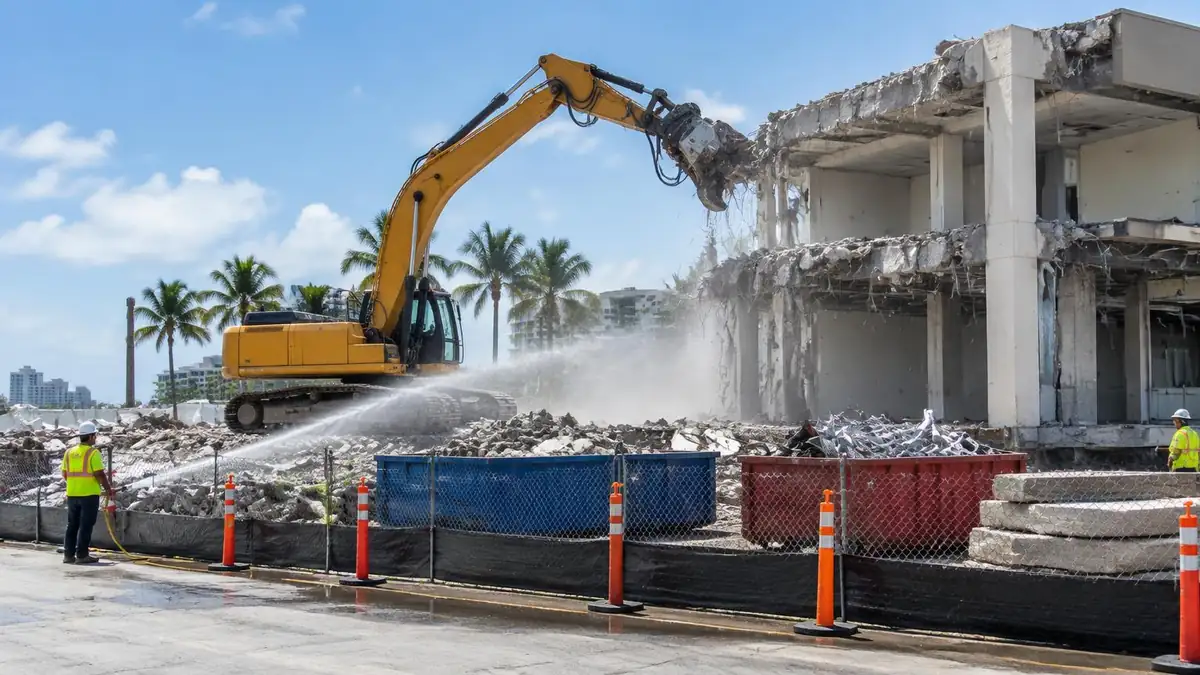
Commercial demolition · Licensed Florida GC
Commercial demolition is removing all or part of a retail, office, warehouse, restaurant or multifamily building, or stripping out its interior, in a way that sets up the project that comes next. We do it across South Florida under Florida license CGC1541479.
State-certified Florida GC
CGC1541479, valid in every county
Demolition experience
Team experience since 2007
South Florida coverage
Miami-Dade, Broward & Palm Beach
A controlled start to finish
A commercial job usually includes the permit, an asbestos survey and the asbestos notice required before demolition, utility disconnects, protection of neighbors and the public, hauling with disposal tickets, and site cleanup. The schedule depends on the building's size, access and approvals, and the work is sequenced around your property, neighbors, schedule and the next trade.
Complete removal of commercial structures with equipment, hauling and site closeout matched to the redevelopment plan.
Targeted structural or interior removal for renovations, expansions and tenant improvement programs.
Equipment-led demolition planned around large footprints, heavy materials, access limits and active neighboring operations.
Sequenced demolition designed around property access, operating hours, neighboring tenants and construction milestones.
Removal of slabs, foundations, loading areas, paving and site concrete included in a defined scope.
Debris loading, lawful disposal and practical material separation with a clear final site requirement.
Our process
We review plans, site logistics, structure type, neighboring uses and the schedule driving the work.
Removals, exclusions, site controls, access, hauling and permit responsibilities are defined in writing.
Crews and equipment follow the approved sequence while maintaining site separation and debris flow.
Debris is removed and the property is left in the condition established for construction or redevelopment.
Project planning
Equipment access, truck routes, staging, overhead conditions and neighboring traffic shape the demolition sequence.
Projects near tenants or the public require clear separation, signage, dust controls and agreed working hours.
Slab elevation, remaining utilities, grading and preservation items should support the trades that follow.
South Florida specifics
A lot of commercial demolition happens inside buildings that stay open: a retail unit next to operating stores, an office floor above working tenants, a restaurant in a plaza. We phase the work, build dust partitions, keep exits and fire protection systems working, and schedule loud work and debris removal around building management rules and business hours.
Commercial buildings need an asbestos survey before demolition, and federal rules require a written notice of demolition at least 10 working days before work starts, even when no asbestos is found. In South Florida that notice goes to the county program, not the state: DERM in Miami-Dade ($225 for a demolition up to 5,000 square feet, $400 above), the Air Quality program in Broward, or the Department of Health in Palm Beach County ($250 for a building under 30,001 square feet). The residential exemption in the federal rules doesn't apply to commercial buildings, so even an interior renovation needs the survey first, and a notice once the regulated asbestos reaches 260 linear feet, 160 square feet or 35 cubic feet. Any abatement is done by state-licensed abatement contractors before demolition.
Building recertification programs in Miami-Dade and Broward, and Florida's milestone inspection law for older condominium buildings, have pushed some owners to compare repair costs with demolition and redevelopment. We work with owners, associations, engineers and attorneys when a building is ordered vacated, declared unsafe, or simply costs more to repair than it is worth.
The timelines are tighter than many owners expect. Miami-Dade now requires recertification at 30 years and every 10 years after, with the report due 90 days after the county's notice. Broward's program starts at 25 years under its Board of Rules and Appeals policy, with 180 days to file the report and 180 more to finish repairs.
We walk through the rules and the repair-or-demolish decision in our guide to failed building recertification.
The building department where the property sits issues the demolition permit, but the asbestos side runs through the county, and each county has its own quirks.
We pulled the actual numbers from each city's fee schedule in our demolition permit fee study.
Some commercial buildings come with systems a demolition crew can't legally handle alone. A restaurant has a grease interceptor, a pressurized hood suppression system, walk-in coolers with refrigerant and gas lines. A gas station has underground fuel tanks with their own closure rules. We line up the licensed trades for each and keep the paperwork, so the permit closes and the landlord or buyer has a clean file.
Read the system-by-system breakdown in our restaurant demolition guide.
Downtown Miami, Brickell, Miami Beach and downtown Fort Lauderdale sites rarely have room to spare. The plan covers sidewalk and lane closures with any required traffic control permits, haul routes, truck staging, work-hour limits, dust and noise control, and protection of adjacent buildings and utilities.
Commercial pricing depends on the building, not just its square footage. These are the items that move a number up or down:
Answers before work begins
We evaluate retail, office, warehouse, hospitality, multi-family and other commercial structures for full or selective demolition based on access, construction and project requirements.
Selective work may be phased around occupied areas when the site and scope allow it. The plan should address separation, access, noise, dust and work-hour requirements before mobilization.
Yes. Commercial scopes can include slabs, footings, foundations, paving and other concrete removal when identified in the proposal.
Pricing reflects structure size and construction, access, equipment, disposal volume, hazardous-material responsibilities, site controls, schedule and required final condition.
It depends on the building, not just its size: construction type, height, asbestos found in the survey, foundations, hauling distance and whether the building is occupied all move the price. The permit itself is a small part. In the 2026 fee schedules we compared, demolition permit fees in South Florida cities ran from about $80 a trade to $340 a structure, plus 2.5% in state surcharges and a county asbestos notice fee of $225 in Miami-Dade or $250 in Palm Beach County. We give a written quote after walking the site.
Yes. Under the federal asbestos rules, the owner or operator of a commercial building has to have it thoroughly inspected before any demolition or renovation, and a full demolition needs a written notice at least 10 working days ahead even if no asbestos is found. The residential exemption doesn't apply to commercial buildings.
A demolition permit from the city or county building department where the building sits, the asbestos survey and county notice, utility disconnect and sewer cap or septic paperwork, and often traffic control or right-of-way permits for sidewalk and lane closures. Restaurants and gas stations add their own steps, like grease trap and fuel tank rules.
Yes. We take tenant spaces down to the condition the lease or the landlord requires, which can mean everything out to the slab or leaving the hood, grease trap and walk-in for the next restaurant. Get the landlord's scope in writing first, and we quote from that list.
Where we work
Google reviews
“We hired Rosemont to gut part of our office in Fort Lauderdale and we couldn't be happier. Permits came through and they were here right away, no waiting around for a week. The crew was careful and responsible the whole time. We had areas and fixtures that needed to stay and they protected all of it, nothing got damaged. They worked fast, cleaned up after themselves and were done sooner than I expected. Easy people to deal with. Would definitely use them again.”
“Used Rosemont to gut the inside of our warehouse in Hallandale and they were great. The guys were careful, taped everything off and wore their gear the whole time, which I really appreciated since we still had people in and out of the building. Their price beat the other quotes I got by a good amount, and there were zero surprises on the final bill. They showed up exactly when they said they would every day, which is rare these days lol. Super friendly crew too, easy to talk to and they kept me in the loop the whole way. Will definitely be calling them again.”
Explore our services
Plan with confidence
Start with a clear scope
We’ll review the property, access, schedule and desired final condition before pricing the work.